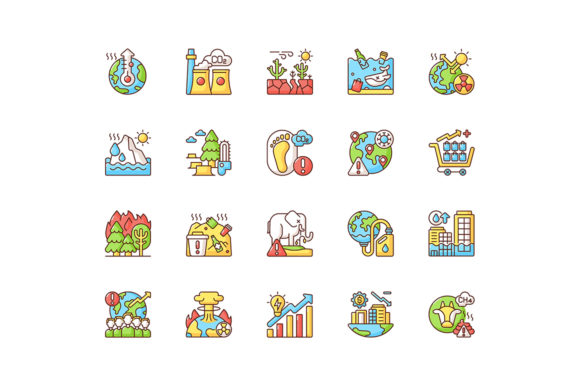
Global Warming RGB Color Icons Set
A Designer’s First Look: Clean, Conceptual, and Carefully Balanced
Opening the Global Warming RGB Color Icons Set, I immediately noticed its visual restraint — no cluttered backgrounds, no forced realism, just isolated vector illustrations built around a clear climate-conscious theme. The RGB color palette isn’t garish or screen-dominant; instead, it uses soft reds, cool blues, and muted greens in ways that feel intentional, not trendy. As an embroidery designer who regularly translates digital graphics into stitched texture, I appreciated how each icon avoids micro-detail — no tiny leaves, no intricate cloud gradients, no overlapping line work that would collapse under satin stitch. These aren’t “cute” icons. They’re thoughtful, scalable, and quietly urgent — perfect for a boutique tote bag, a minimalist nursery pillow cover, or an embroidered apron for an eco-conscious café.
How It Stitches: Real-World Embroidery Behavior
I tested three icons from the set on midweight cotton twill (for a custom sweatshirt), organic cotton jersey (for a baby onesie), and linen-cotton blend tea towels. On stable fabric with light cutaway stabilizer, the Global Warming RGB Color Icons Set translated cleanly: clean satin-stitched outlines held shape, fill stitches remained even, and the open negative space between elements prevented thread buildup. On the stretchy jersey, however, I needed a tear-away + topping combo — especially around curved edges like the globe silhouette — to keep registration tight and avoid puckering. That’s not a flaw in the design; it’s a reminder that vector clarity doesn’t automatically equal embroidery forgiveness.
This set shines brightest in medium-to-large applications: 3–4 inch embroidered patches, center-chest sweatshirt designs, or full-front tote bag motifs. It’s less ideal for tiny cap logos or cuff details — the symbolic shapes (thermometer, melting iceberg, leaf-and-flame) rely on proportion and breathing room. You’ll want at least a 4-inch hoop to honor the balance between graphic weight and stitch legibility.
Where It Fits — and Where It Doesn’t
- Works beautifully for: Custom apparel (especially unisex sweatshirts and oversized tees), embroidered kitchen towels, nursery decor (think “Earth-Friendly Baby” pillow covers), holiday gifts with purpose (e.g., Earth Day tote + matching patch set), and Etsy listings where storytelling matters — customers respond well to design that feels ethically grounded, not preachy.
- Use carefully on: Dark fabrics (test thread contrast first — some RGB blues fade visually on charcoal or navy), textured surfaces like bouclé or heavy terry cloth (fill areas may lose definition), and layered garments like quilted jackets (hoop clearance and stabilizer choice become critical). Avoid dense stitching clusters on curved caps — simplify or reposition if using for headwear.
What It Adds to Your Finished Product
The Global Warming RGB Color Icons Set elevates handmade presentation without sacrificing authenticity. Unlike clip-art-style climate graphics, these icons carry quiet authority — they don’t shout, but they hold attention. That builds customer trust, especially for small shop owners and craft fair sellers positioning themselves as mindful makers. When stitched on a natural-fiber tote or organic cotton tea towel, the design reinforces brand consistency: calm, considered, and cause-aligned. Buyers notice that. They photograph it. They tag your shop. And yes — it increases giftability. A personalized baby blanket with the leaf-and-flame icon feels meaningful, not generic.
Practical Notes Every Embroidery Designer Should Check
- Always test on scrap fabric first — especially if pairing with applique or combining multiple icons into one layout.
- Review stitch density before scaling up — vector files don’t show stitch count, so run a simulation or consult your machine’s software preview.
- Confirm hoop size compatibility — the ZIP includes EPS, JPG, PNG, and SVG, but none are native embroidery formats. You’ll need to digitize or convert responsibly.
- Inspect small corners and joins — vector sharpness doesn’t guarantee clean satin stitch turns. Some curves may need manual smoothing in your digitizing software.
- Test black-and-white mockups — this set relies on color meaning, but many buyers view products in grayscale thumbnails (Etsy, Instagram feeds). Does the icon retain identity without RGB?
- Compare light vs. dark fabric backgrounds — what reads as “cool blue” on white may disappear on heather grey unless thread is adjusted.
- Use proper stabilizer — lightweight cutaway for stable wovens, tear-away + topping for knits or textured weaves.
- Verify licensing — since this is a digital embroidery file sold as Graphics, confirm whether commercial use (i.e., selling finished embroidered products or digital bundles) is permitted before listing on Etsy or wholesale platforms.
A Final Thought for Craft Business Owners
If you sell personalized gifts, custom apparel, or boutique-branded merchandise, the Global Warming RGB Color Icons Set offers more than visual appeal — it adds narrative depth. People don’t just buy embroidered items; they buy intention. This set lets you speak to values without words: sustainability, care, awareness. But intention needs execution. So digitize thoughtfully, stabilize deliberately, and always let the fabric — and your customer’s expectations — guide your choices. Done right, this isn’t just another machine embroidery design. It’s a quiet, stitched statement — and that’s exactly what makes it worth your time.